Aviation Technologies have completely transformed the aviation industry by making aircraft safer, faster, more efficient, and more reliable than ever before. From powerful jet engines to advanced satellite communication systems, these Aviation Technologies continue to improve flight operations, passenger comfort, fuel efficiency, and the future of global air travel.
Top 10 Aviation Technologies That Changed Flying Forever
10. Satellite Communication (SATCOM)
Introduced: 1980s
Developed By: Inmarsat and Aviation Communication Providers
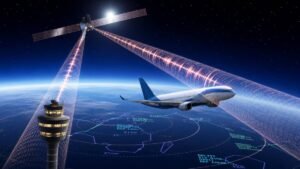
Satellite Communication (SATCOM) allows aircraft to stay connected with ground stations using satellites, even when flying over oceans, deserts, or remote areas where normal radio signals cannot reach. This technology has greatly improved flight safety, aircraft tracking, communication, weather updates, and passenger internet services on modern commercial flights worldwide.
Today, SATCOM supports voice communication, operational messages, real-time aircraft monitoring, weather information, and onboard Wi-Fi. It helps pilots and airlines stay connected throughout the journey, making flights safer, more efficient, and more comfortable for passengers across long international routes.
How It Changed Aviation
– Enabled seamless worldwide communication between aircraft and ground stations.
– Improved global flight tracking through advanced Aviation Technologies and real-time position monitoring.
– Provided pilots with accurate real-time weather updates for safer flight operations.
– Enhanced airline operational efficiency through faster and more reliable data communication.
– Delivered reliable in-flight internet connectivity for both passengers and flight crew.
Examples: Airbus A350, Boeing 787 Dreamliner, Airbus A330neo
9. Enhanced Ground Proximity Warning System (EGPWS)
Introduced: 1990s
Developed By: Honeywell
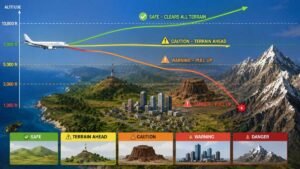
The Enhanced Ground Proximity Warning System (EGPWS) helps pilots avoid mountains, hills, buildings, and other terrain during flight. By using GPS and a digital terrain database, it gives early warnings before the aircraft gets too close to the ground, greatly reducing the risk of Controlled Flight Into Terrain (CFIT) accidents.
EGPWS gives clear voice alerts like “Terrain” and “Pull Up” whenever danger is detected. These warnings provide pilots with valuable time to react quickly, making the system one of the most important safety technologies used in modern commercial aircraft.
How It Changed Aviation
– Reduced the risk of terrain-related accidents during critical phases of flight.
– Improved pilot situational awareness through advanced Aviation Technologies and terrain awareness systems.
– Increased pilot reaction time by providing timely terrain hazard warning alerts.
– Enhanced safety during operations in mountainous and other challenging terrain environments.
– Improved overall flight safety by preventing controlled flight into terrain incidents.
Examples: Airbus A320, Boeing 787, ATR 72
8. Traffic Collision Avoidance System (TCAS)
Introduced: 1980s
Developed By: FAA, ACSS
The Traffic Collision Avoidance System (TCAS) continuously monitors nearby aircraft and warns pilots if another aircraft comes too close. It works using transponder signals and automatically provides instructions to climb or descend, helping pilots avoid possible mid-air collisions without depending only on air traffic control.
TCAS operates independently and gives quick traffic alerts whenever another aircraft enters a dangerous distance. Today, it is a required safety system on most commercial aircraft and has played a major role in preventing mid-air accidents worldwide.
How It Changed Aviation
– Prevented potential mid-air collisions through continuous aircraft surveillance systems.
– Improved pilot traffic awareness using advanced Aviation Technologies for aircraft surveillance.
– Increased overall flight safety by reducing the risk of airborne traffic conflicts.
– Assisted pilot decision-making during complex and congested airspace operations.
– Operated independently of air traffic control to enhance situational awareness.
Examples: Boeing 777, Airbus A350, Boeing 737
7. Weather Radar
Introduced: 1950s
Developed By: Honeywell, Collins Aerospace
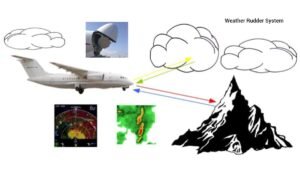
Weather Radar helps pilots detect thunderstorms, heavy rain, turbulence, hail, and other dangerous weather before reaching them. By showing weather conditions on cockpit displays, pilots can safely change their route, reducing risks and providing a smoother and safer flight experience for everyone onboard.
Modern weather radar displays weather in different colors, making it easy for pilots to understand storm intensity. This allows better flight planning, avoids severe weather, reduces turbulence, and improves passenger comfort throughout the journey.
How It Changed Aviation
– Improved weather avoidance through accurate Aviation Technologies and real-time weather detection.
– Reduced turbulence encounters by helping pilots select safer and more efficient flight paths.
– Increased passenger safety during flights affected by adverse and rapidly changing weather conditions.
– Enhanced flight planning with timely, accurate, and reliable weather information.
– Prevented weather-related accidents by identifying hazardous weather systems at an early stage.
Examples: Boeing 737 MAX, Airbus A320neo, Boeing 787
6. Composite Materials
Introduced: 1980s
Developed By: Boeing, Airbus, Hexcel Corporation
Modern aircraft use composite materials, such as carbon fiber, instead of only aluminum. These materials are lighter, stronger, and more resistant to corrosion. They help aircraft burn less fuel, carry more passengers, and require less maintenance, making flying more efficient and environmentally friendly.
Composite materials are widely used in aircraft wings, fuselage sections, tail structures, and cabin components. Their lightweight design improves aircraft performance, lowers operating costs, increases durability, and provides airlines with better fuel savings over many years of service.
How It Changed Aviation
– Reduced overall aircraft weight through the use of advanced composite Aviation Technologies.
– Improved fuel efficiency by minimizing aircraft weight and aerodynamic drag.
– Increased aircraft strength while maintaining a lightweight structural design.
– Lowered maintenance costs with corrosion-resistant and durable composite materials.
– Extended aircraft service life through enhanced structural durability and reliability.
Examples: Boeing 787 Dreamliner, Airbus A350, Airbus A220
5. Autopilot System
Introduced: 1912
Inventor: Lawrence Sperry
Developed By: Sperry Corporation
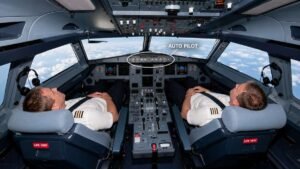
The Autopilot System automatically controls an aircraft during different stages of flight while pilots continue to monitor everything. It helps maintain altitude, speed, heading, and navigation accurately, reducing pilot workload and making long flights safer, smoother, and more comfortable for both pilots and passengers.
Today’s autopilot systems work together with GPS and flight management computers to assist during climb, cruise, descent, and even automatic landing at selected airports. This technology improves flight accuracy, fuel efficiency, and overall operational safety.
How It Changed Aviation
– Reduced pilot workload by automating routine flight control functions.
– Improved flight accuracy through precise navigation and automated control systems.
– Increased operational safety using advanced Aviation Technologies to minimize human error.
– Saved fuel by optimizing flight paths and improving overall aircraft performance.
– Assisted safe automatic landings during low-visibility and adverse weather conditions.
Examples: Airbus A380, Boeing 787, Boeing 777
4. GPS Navigation
Introduced: 1978 (GPS Satellites)
Developed By: U.S. Department of Defense
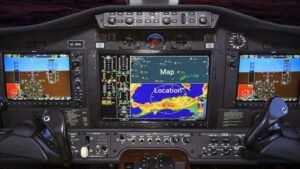
GPS Navigation allows aircraft to know their exact position anywhere in the world using satellites. It replaced many traditional ground-based navigation systems and made flying more accurate, safer, and more efficient while helping airlines choose shorter routes and reduce fuel consumption.
Modern GPS supports advanced navigation procedures, precise aircraft tracking, and accurate approaches during landing. It helps pilots fly safely over oceans and remote areas while improving route planning and reducing overall flight operating costs.
How It Changed Aviation
– Improved navigation accuracy through highly precise satellite-based positioning systems.
– Reduced flight distance by enabling more direct and efficient aircraft routing.
– Saved fuel by optimizing flight paths using advanced Aviation Technologies.
– Increased flight safety with accurate and reliable real-time navigation information.
– Enabled precise global navigation for aircraft operating safely around the world.
Examples: Boeing 787, Airbus A320neo, Gulfstream G700
3. Glass Cockpit
Introduced: 1970s
Inventor: Multiple Avionics Engineers
Developed By: Honeywell, Collins Aerospace, Garmin
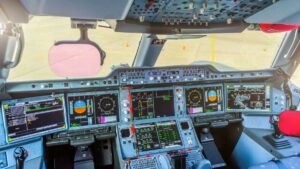
The Glass Cockpit replaced many traditional analog gauges with large digital screens that display flight, engine, navigation, and aircraft system information in one place. This makes it easier for pilots to monitor the aircraft, improves decision-making, and reduces workload during every phase of flight.
Modern glass cockpits combine weather information, navigation maps, terrain awareness, engine monitoring, and warning systems into easy-to-read displays. This helps pilots access important information quickly, making flights safer, more efficient, and easier to manage.
How It Changed Aviation
– Reduced pilot workload by integrating critical flight information into one display.
– Improved situational awareness with accurate real-time flight and navigation data.
– Enhanced flight monitoring through advanced digital Aviation Technologies and cockpit displays.
– Increased operational safety by providing clear and accurate flight information.
– Simplified cockpit management with an integrated and fully digital glass cockpit environment.
Examples: Boeing 737 MAX, Airbus A350, Embraer E195-E2
2. Fly-By-Wire (FBW)
Introduced: 1972 (Experimental), 1988 (Commercial)
Inventor: NASA & Aerospace Engineers
Developed By: Airbus, NASA, Dassault Aviation
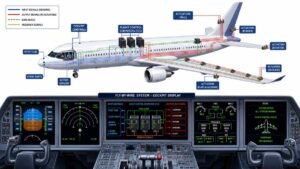
The Fly-By-Wire (FBW) system replaces traditional mechanical control cables with electronic signals controlled by flight computers. This makes aircraft lighter, safer, and easier to fly while improving fuel efficiency and allowing advanced flight protection features that prevent dangerous flying conditions.
Modern FBW systems constantly monitor pilot inputs and automatically keep the aircraft within safe operating limits. They improve handling, reduce maintenance, increase reliability, and help pilots control modern aircraft more smoothly under different flight conditions.
How It Changed Aviation
– Improved overall flight safety through advanced fly-by-wire control technology.
– Reduced aircraft weight by replacing heavy mechanical control systems.
– Increased fuel efficiency with advanced Aviation Technologies and optimized flight controls.
– Lowered maintenance costs through simplified and highly reliable electronic systems.
– Prevented unsafe maneuvers by automatically enforcing aircraft flight envelope protection.
Examples: Airbus A320, Airbus A350, Boeing 777
1. Jet Engine (Turbojet & Turbofan)
Invented: 1930
Inventor: Sir Frank Whittle (United Kingdom) & Hans von Ohain (Germany)
Developed By: Power Jets Ltd., Heinkel Aircraft Company, Rolls-Royce, General Electric
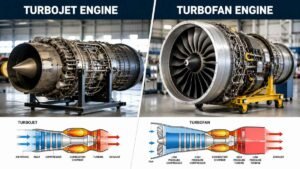
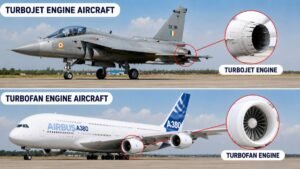
The Jet Engine completely changed aviation by replacing slower piston engines with powerful turbine engines. It allowed aircraft to fly much faster, higher, and farther than ever before. This invention made modern commercial air travel possible and connected countries around the world through faster and more reliable flights.
Turbojet engines entered service during the 1940s, while modern turbofan engines later improved fuel efficiency, reduced engine noise, produced greater thrust, and became the preferred engine type for almost every commercial passenger aircraft flying today.
How It Changed Aviation
– Increased aircraft speed with more powerful and efficient jet engine technology.
– Enabled long-distance flights through improved engine performance and fuel efficiency.
– Improved fuel efficiency by optimizing engine design and aerodynamic performance.
– Reduced engine noise with advanced turbofan and noise-reduction technologies.
– Increased passenger and cargo capacity for more efficient commercial air transport.
Examples: Boeing 787 Dreamliner, Airbus A350, Boeing 777
Note: Modern Aviation Technologies have significantly improved aviation safety, navigation, communication, and aircraft performance. As innovation continues, Aviation Technologies will play an even greater role in making future flights safer, smarter, more efficient, and environmentally friendly for everyone.